

What happened when Israel Occupation Forces silenced a San Diego mother on the high seas — and what she said when she came home
Written By Aalia Lanius, Editor UNSUGARCOATED Media
I had known for a few days that she was out there.
Meagan Marie Dominguez — Mea, to those who love her — was aboard the Global Sumud Flotilla, somewhere on the Mediterranean, sailing toward Gaza. I had been watching. Waiting. Feeling that particular dread that settles in your chest when someone you admire is doing something brave and dangerous and necessary, and there is nothing you can do but bear witness from a distance.
I had felt aligned with Mea for years. I had seen her stand up for immigrants facing ICE brutality, for communities crushed under the weight of policies that treat human beings as inconveniences. Her advocacy always struck me as something rare — not performative, not curated for an audience, but visceral. Instinctive. Like she simply could not help it. As a mother myself, I understood her in a way that went beyond politics. She was someone who looked at suffering and found it physiologically impossible to look away.
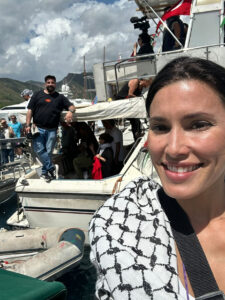
(Photo provided by Meagan Maria Dominguez)
She was on a boat sailing toward a genocide, carrying aid, carrying witness, carrying the stubborn and radical belief that human beings matter.
I knew the chances of breaking through were slim. We all did. Israel has intercepted every flotilla attempt for years, in defiance of international law, in defiance of basic human decency, operating with the impunity that only comes when the most powerful government on earth is writing your checks and covering your crimes.
One of her messages to me carried the weight of that knowledge. I pray we break through.
Five words. I have turned them over in my mind many times since.
There is something almost unbearable about that sentence — not despair, exactly, but a clear-eyed acknowledgment of the odds, offered without self-pity. She knew. She went anyway.
And then her messages stopped. When they did, so did my heart.
I sat with my phone, taking slow deliberate breaths, knowing that on the other side of that silence was not a dead battery or a lost signal. It was something deliberate. Something calculated. I waited for confirmation of what I already knew.
What I did not yet know — what none of us knew — was precisely how it had happened. The interception of the Global Sumud Flotilla was not a sudden ambush at dawn. It was something colder, more surgical, and in some ways more chilling than a naval confrontation. Before a single Israeli warship appeared on the horizon, before a single soldier set foot on deck, the operation had already begun.
Israel hacked the flotilla’s Starlink connection and changed the Wi-Fi password.
“I was getting ready to send the interview to you,” Mea told me days later, when we finally spoke. “And I was logged out of the internet. I go inside to the boat and I was like, ‘Hey, maybe I have the wrong Wi-Fi password,’ and they’re like, ‘They changed it. It’s done.'”
In an instant, the flotilla was dark. No livestreams. No emergency communications. No ability to go live and let the world watch. The hacking of the Starlink was not incidental — it was the first strike. Silence the witnesses before you commit the act. Cut the signal before you cut the hull.
Mea found one remaining camera feed — a secondary system the ship used to broadcast its deck to outside observers — and managed to get a message out through that narrow channel: Our password has been changed. There are two warships approaching. They are jamming the SOS channels.
Then the speedboats came, playing music through their speakers, drowning out the international distress frequency on Channel 16.
The crew had drilled for this. They knew what to do: passports, life jackets, sit down. Mea told me this was her first interception, and she had braced herself not knowing how her own body would respond to soldiers screaming in her face, to the adrenaline, to fear translating itself into something physical and uncontrollable.
“Until you were in the presence of those soldiers being yelled at,” she said, “it’s hard to know exactly what your temperament is, how you’re going to react to that situation, what your triggers are, and how much patience and space you can have for yourself.”
She dissociated. She made herself remember that the behavior of these soldiers was not a reflection of her. She made herself remember that they were, in her words, “very mentally and emotionally sick individuals.” She held herself together by thinking of Palestinian children — children who have no such dissociation available to them, no diplomatic passports, no tweets from US representatives, no light at the end of the tunnel.
“I kept imagining these Palestinian children,” she said, “and how that would forever change them. I just can’t imagine growing up in that situation, in that type of fear.”
What followed belongs to the category of things that should not happen in a civilized world. The fact that they did happen — to unarmed civilians, aid workers, journalists, doctors, and a mother from San Diego — is not an anomaly. It is a policy.
The activists were transferred to a Navy war vessel. They were blindfolded. Their wrists were zip-tied — more tightly, Mea noted, for the men with darker skin. They were forced to kneel face-down on the ship’s non-skid deck — a coarse, abrasive surface designed for traction, designed to tear into skin. Some had their ankles zip-tied as well. They were held in these positions for what Mea estimates was between one and three hours.
Israeli Occupation officers moved among them, performing cruelty as theater. They would crouch down and ask, sweetly: Are these zip ties too tight? Do you want them loosened? Then walk away laughing. When a woman beside Mea refused to accept water — I don’t want any Zionist water — the soldiers swarmed her like, in Mea’s word, hyenas. They threw water on the detainees. They stepped on fingers.
Then came the prison ship, and what Mea calls the beating container.
“They grabbed the back of my head and shoved it down,” she said. There were questions about medical history — do you take medication, do you have any conditions — delivered with the false concern of people about to make that information relevant. When Mea refused to answer, an officer grabbed her by the back of the neck and forced her to the ground. We need to know if you need to see a doctor, they yelled. We need to know.
“I said, ‘I don’t need to see a doctor unless you guys hurt me,'” Mea told me. “The lady gave me a smirk and said, ‘Oh, we’re not going to hurt you.'”
Then they threw her into the beating container. Three men were waiting inside.
“The first man took all the swings on me,” Mea said, her voice steady in a way that made it worse to hear. “That first swing pretty much knocked me out. It would go from bright to dark, bright to dark, one after another. He had to hold me up by my hair because I was kind of falling over. And because the hit was on my head and my face, I couldn’t react. I didn’t put my hands up, I didn’t scream, I couldn’t do anything, because mentally it was just out.”
She paused.
“My beating was actually pretty short,” she said — and the fact that she framed this as something approaching luck is its own devastating indictment. The soldiers, she explained, fed on reaction. Screaming. Struggling. Fear they could see. Mea gave them nothing. There was nothing to energetically consume. So, they tossed her to the two men at the back of the container, and it was over.
She emerged into a courtyard where the people who had arrived the day before had already organized themselves into a functioning community of survival. They had improvised a medical station. They had fashioned slings from plastic bags, eye patches from torn cloth, bandages from whatever could be found. When a new boat arrived and new detainees emerged from the beating containers, a welcoming party was ready — someone to take you by the arm, someone to check your wounds, someone to press bread against the lacerations on your face.
“The men would take the shirts off their backs,” Mea said, “and give them to the women.”
This, too, is a kind of politics. This is what it looks like to maintain humanity under conditions specifically designed to strip it away.
At some point — Mea is not certain of the exact sequence, because time had become elastic, punctuated by sound bombs and strobe lights and the random crack of rubber bullets fired from the railing above for no reason except that they could — the Israeli Occupation soldiers herded everyone into the courtyard.
Twenty of them came out in full SWAT gear. Shields. Masks. As though the unarmed, beaten, zip-tied civilians in front of them — people who had already been stripped and searched multiple times — represented a credible threat. They threw stun grenades into the crowd.
“You don’t just hear it,” Mea said. “It’s in your chest. Your body shakes. All of the liquid inside your body vibrates. You feel it go deep into you. And they know that’s the reaction people have.”
And then, into that — into the smoke and the ringing and the terror — stepped Dr. Margaret Connolly.
Margaret Connolly is the sister of the President of Ireland. She is a physician. She was a detainee, beaten and cold and exhausted like everyone else. And she walked out into the courtyard while Israeli soldiers had their guns pointed at her and she said, in a voice that carried despite the fact that it was shaking: I am a doctor. We have injured people here. We need water.
She did not move.
“I remember being so amazed at the bravery of this woman,” Mea told me, and I could hear something shift in her voice. “It’s not that any of us weren’t afraid. We were all terrified. And I know Margaret was afraid too. But it didn’t matter. She still stood up. She had a weapon pointed at her, and she spoke from her chest.”
Mea said she felt, in that moment, like a coward. She had just been beaten. She was concussed — her speech slurred, her vision fractured. She sat against the wall and watched Margaret and thought to herself: don’t do it, they’re going to shoot you.
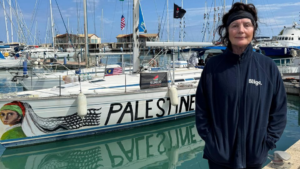
(Via Instagram, Margaret Connolly)
But then something happened. One by one, other detainees stood. They formed a circle around Margaret — fifteen people, then more — standing in front of her, standing behind her, forming a human shield around a doctor demanding water for injured people while soldiers aimed guns at her chest.
“It was just an incredible view of solidarity and bravery,” Mea said, her voice quieter now. “And I thought: this is the Sumud that they talk about. This is what it is. This is the love that Palestinians have always shown — this steadfastness. And all of our motivation and inspiration for being there in the first place.”
The soldiers eventually brought water. They also brought long-sleeve shirts — which they had first soaked with water, because even small cruelties apparently could not be resisted.
The nights were spent in containers packed with 180 people. There was barely room to sit. People slept upright against the walls. Soldiers shone strobe lights through the windows at intervals, denying sleep. Lasers were aimed at people’s eyes in the dark.
Mea lay on the floor pressed against a stranger for warmth, sharing body heat. She used a plastic bag as a blanket and was surprised to find it worked. She thought about her son. She thought about going home. She held onto that — the knowledge that she had a home to go to, a child waiting, people that would advocate on her behalf, friends who would make sure she still had a roof over her head.
“I was getting out,” she said. “It was going to suck, but I was going home. Palestinian children don’t have that safety net. They don’t have that light at the end of the tunnel where you think, just hold on another 24 hours. That camaraderie that we had between each other, that mentally and emotionally saves you — I’ve heard of so many children placed in solitary confinement. A developing, growing child, abused, then put in isolation.”
When Mea was released and finally made it home to San Diego, I watched the video of her embracing her youngl son. I don’t have adequate words for what it was to see that, knowing what I now know about what happened on that ship.
When I asked Mea where her compassion comes from — what it is inside her that makes her stand in front of injustice when others look away — she turned the question around before she even tried to answer it.
“Everybody should have that,” she said. “Where does your humanity come from? You know, my question would be, for the Zionists who are okay with this: where is your humanity? How come you don’t have any humanity in the first place? This is such a natural instinct that people can and should tap into. It was a lot of processing the fear behind doing what is actually just natural — natural for most parents to speak out for children’s rights, to speak out for your neighbor.”
She paused, and then: “It’s not necessarily where does the compassion come from, but how come some people don’t have access to it — that’s the thing that terrifies me about this world.”
Mea is a mother. She watches videos of Palestinian children and she hears, underneath the images, the specific texture of a child’s cry — the exact pitch that her own child makes — and she knows, in her body, what it means for a small person to be that afraid. She told me it hurts in her past lives. I believe her.
In 1948, the United States conducted the Berlin Airlift — daily flights carrying food, medicine, and coal to civilians blockaded in West Germany. The pilots were heroes. The mission was celebrated as one of the defining moral acts of the postwar era. The lesson of World War II, the world told itself, was that humanity must do better. That blockading a civilian population, starving children, cutting off medical supplies — these were the acts of monsters, and the world would not permit them.
Seventy-seven years later, the United States government is openly funding, arming, and diplomatically shielding an operation that has killed hundreds of thousands of Palestinian civilians, leveled hospitals, bombed tent schools, and imprisoned a San Diego mother for the crime of sailing toward a blockade with food and medicine.
“Propaganda works,” Mea said, when I asked her what she wanted to say directly to the American public. “But if you have an inkling that you are right and that somebody is lying to you — do a little bit of research. It really doesn’t take that much to verify information about the crimes that Israelis are committing against Palestinians, and now Lebanon.”
She let that land, then continued.
“We know that segregation and apartheid are wrong. It’s in our own history. Don’t let them tell you there’s any justification for any of these abuses. Because there isn’t.”
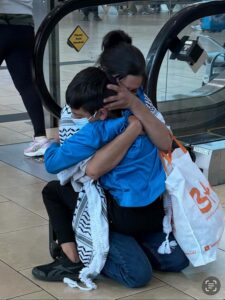
(Photo provided by Meagan Marie Dominguez, embracing her son upon returning.)
When I asked Mea how it felt — as an American citizen who had just been beaten and detained by a foreign military — to watch the US government attempt to deepen its military integration with Israel, she didn’t hesitate.
“Occupied,” she said. “We are under Israeli occupation at this point. And it’s going to get worse.”
Meagan Marie Dominguez is a mother and a San Diego native. She is one of hundreds of civilians — doctors, journalists, activists, teachers, a president’s sister — who looked at what is being done to the Palestinian people and decided that bearing witness from a distance was no longer enough.
She went. She was beaten. And while videos of Ben Gvir taunting blindfolded detainees circulated on social media⎯a grotesque window into a government that mistakes cruelty for strength and a man who has confused brutality with power, Mea — and hundreds like her — returned home carrying exactly what Israel most wanted to extinguish. Hope. Stubborn, unoccupiable, undefeated hope.

STAY CONNECTED FOR
ANNOUNCEMENTS
AND DISCOUNTS
Jugend

Purchase your copy of her
second novel, JUGEND, today
and receive a personalized
copy and bookmark!